
Queensbury City Directory Collections
The confirmed Queensbury directory shelf is narrow but useful. Hamilton Child's 1871 gazetteer and business directory is the direct, named Queensbury source. It can provide names, farms, roads, businesses, and period place labels. It is a dated historical record, not a full list of every household in the town. Later Glens Falls directories have a longer identified run, yet they are an adjacent-city source. A Queensbury address may appear under a Glens Falls postal label, but the volume alone does not establish the legal town or a person's residence.
| Collection | Years | Where Held | Access |
|---|---|---|---|
| Hamilton Child gazetteer and business directory | 1871 | Library of Congress digital item; NYGenWeb finding aid | Public scan; cite page or image |
| Glens Falls city directories | 1871-1990, incomplete | Crandall, New York State Library, and NYGenWeb listings | Regional cross-check; confirm the exact volume |
| Identified New York State Library runs | 1879-1888, 1890-1900, 1903-1920, 1922-1931, 1933-1942, 1944, 1946-1948 | State Library holdings listed through NYGenWeb | Use as a nearby-city source |
| Reverse and telephone directories | No verified Queensbury run located | Catalog or repository inquiry | Do not promise address-to-name coverage |
Those gaps matter. No complete Queensbury reverse or criss-cross directory collection was confirmed, and no exact Queensbury telephone-book run was found in the inspected sources. Use a library or archive catalog before treating either record type as available.
Queensbury's 1871 Directory Starting Point
The NYGenWeb transcription and context page for the 1871 Queensbury directory is a practical way to locate the Hamilton Child material. The Library of Congress catalog identifies the 1871 publication and its public-domain access. Read the scan when possible, because a transcription can miss a spelling, abbreviation, or page layout. Record the publication year and page or image with every useful entry.
The 1871 Queensbury directory source shows the period resource used for this city directory trail.
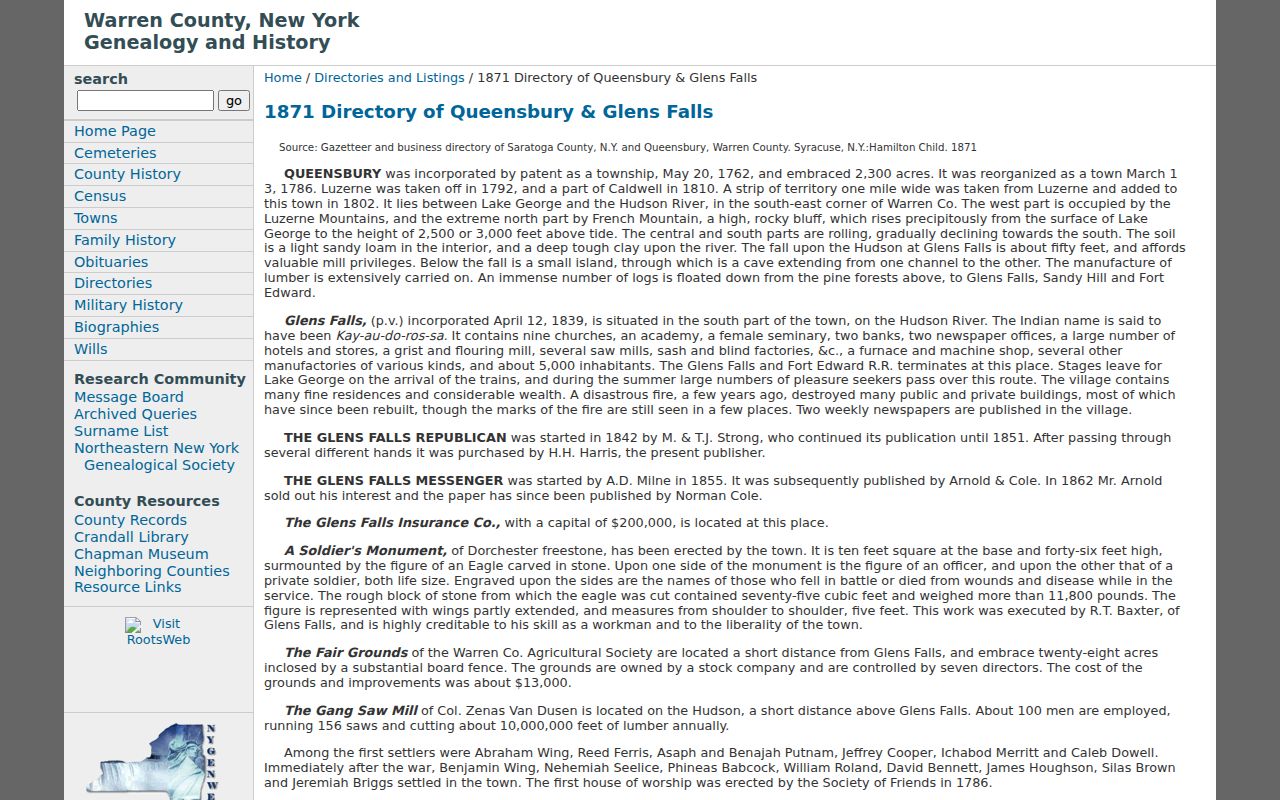
The directory supplies historical context rather than a present-day answer. Search variant spellings, initials, business roles, and old place labels against deeds, assessment rolls, cemetery transcripts, and census material before connecting a name to a Queensbury household.
The long record trail is a local story in itself. Warren County deeds begin in 1813, while the direct directory lead is 1871. The Warren County Historian adds family, cemetery, census, and local-subject files that can help bridge that interval.
Reading Queensbury City Directory Evidence
Only record information that the actual entry supplies. The confirmed 1871 source may expose a name, farm or business reference, road, local geography, and an older post-office designation. It does not justify importing standard city-directory fields from another place. In particular, no local owner mark, renter mark, or reverse section has been verified for Queensbury. Preserve the words and punctuation that appear in the source, then note what another record independently confirms.
| Name | Copy the indexed or printed spelling, including initials or abbreviated given names. |
|---|---|
| Place reference | Record the road, farm, post-office label, or locality exactly as printed. |
| Business or farm context | Use it only when the entry actually provides it; it can help distinguish namesakes. |
| Source citation | Keep the year, page or image, repository, and whether the wording came from a scan or transcription. |
| Later confirmation | Separate the directory statement from a deed, census, cemetery, or archival finding. |
- Criss-cross directory
- A directory arranged by street and number rather than surname. It is a general research term; no verified Queensbury criss-cross run was located.
- Householder listing
- A name associated with a household in a dated source. It should not be treated as proof of ownership or long-term occupancy.
- Abbreviation key
- A publisher's explanation of shortened terms, when a volume includes one. Photograph or transcribe it before interpreting any notation.
Queensbury Household Records at Crandall
Crandall Public Library's Folklife Center holds city directories, local newspapers, maps, photographs, Glens Falls and Queensbury vertical files, biographical files, scrapbooks, family papers, and organizational records. Its staffed research room and library databases give a concrete fallback when a name does not appear in the one confirmed Queensbury directory. The collection also identifies Queensbury School District No. 20 records from 1823-1881 and Bay Road Presbyterian Church records from 1849-2003.
For a surname or address question, give staff the original name spelling, any alternate place label, a date range, and the record already checked. The center's newspaper sources can help test a move, death, sale, or organizational connection. The Post-Star begins on microfilm in July 1909, its 1909-1919 issues are available through New York State Historic Newspapers, and Miller scrapbooks cover about 1870-1955.
The Warren County Historical Society, at 50 Gurney Lane in Queensbury, is another documented local-history channel for archives, books, maps, photographs, and manuscripts. Ask for an access condition or finding aid instead of assuming that every collection is online.
Queensbury Directory Checks Near Glens Falls
Glens Falls became an incorporated city in 1908 after separating from Queensbury. That history, together with Queensbury's close geography and postal overlap, makes nearby directories useful but limited. A city directory headed Glens Falls may contain a lead for a Queensbury road or family. Verify the address against the town parcel, a Warren County deed, census material, or an archive record before assigning the entry to Queensbury.
Place names also change meaning over time. Keep a source's wording, whether it says Glens Falls, West Glens Falls, Lake George, Cleverdale, or Queensbury. A modern map can locate a road, but it cannot replace a dated record that explains what the historical label meant. Note: A neighboring-city listing is evidence to investigate, not a complete Queensbury directory run.
Tracing Queensbury Households Across Records
Follow a household through dated records instead of filling a gap with assumptions. Start with the 1871 entry or another confirmed name-and-place reference. Then search the relevant census index or transcript, record every spelling variation, and check whether a deed, assessment roll, or cemetery transcript supports the same time and place. A person who vanishes from one source may have moved, died, appeared under another spelling, or simply not been included by that publisher.
- Transcribe the directory name, place wording, year, and page exactly.
- Search the Warren County Historian's surname and census material with spelling variants and initials.
- Compare the dated location with a Warren County deed, assessment record, map, or parcel description when the question concerns land.
- Use a nearby Glens Falls volume only as a regional check, then verify the town or situs with a separate record.
- Close the research trail with an obituary, cemetery transcript, estate file, or archival citation where appropriate.
Ownership and household evidence answer different questions. A recorded instrument identifies parties to that instrument; a directory or census may describe a household at a particular time. Neither should be silently substituted for the other.
Queensbury Census Records After the Capitol Fire
Queensbury has an unusually useful census fallback. The state census schedules from 1825-1905 were largely destroyed in the 1911 State Capitol fire, but many county clerks kept duplicates and the State Library holds microfilm of county material from 1855-1905. The Historian specifically identifies a surviving 1855 Queensbury transcript and indexes for 1855, 1860, 1865, 1875, and 1910. Search the county copy, Historian material, and state or federal channels rather than expecting one complete collection.
Warren County's archival series inventory identifies the historical record groups that can support a directory result.
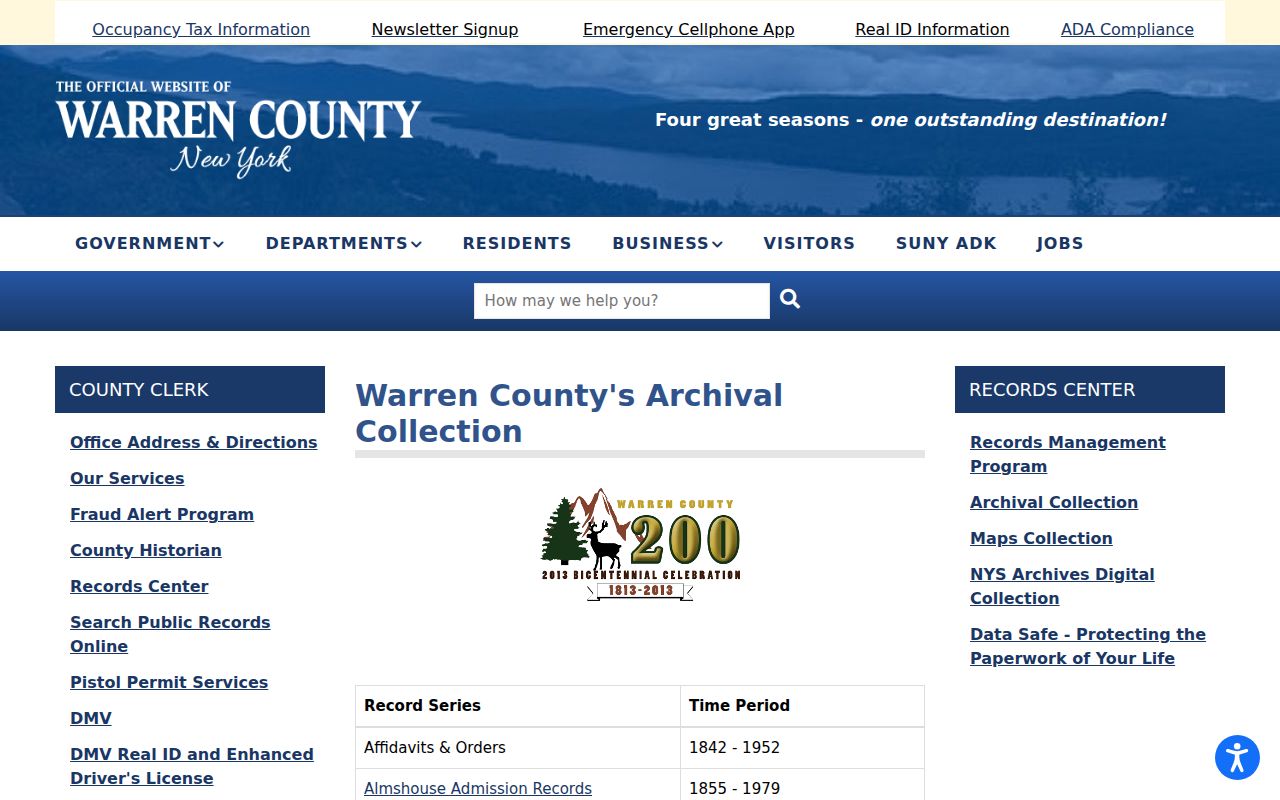
The archive lists census records from 1830-1925, assessment and tax rolls from 1854-1989, and deeds from 1813 onward. A series date tells the researcher where a record may exist; access can still depend on the series and any applicable restriction.
Queensbury Archive Record Index Leads
The county's date-sorted Queensbury archival town index is a catalog route, not a modern resident list. It displays date, name, description, town, record-series or catalog ID, and image ID. Entries such as a 1950 Cleverdale Road plat reference or a 1970 Route 9 estate reference can supply a precise request for the underlying item. The index entry itself does not establish ownership or occupancy.
The Warren County Queensbury town index illustrates the archive fields available for a city directory follow-up.
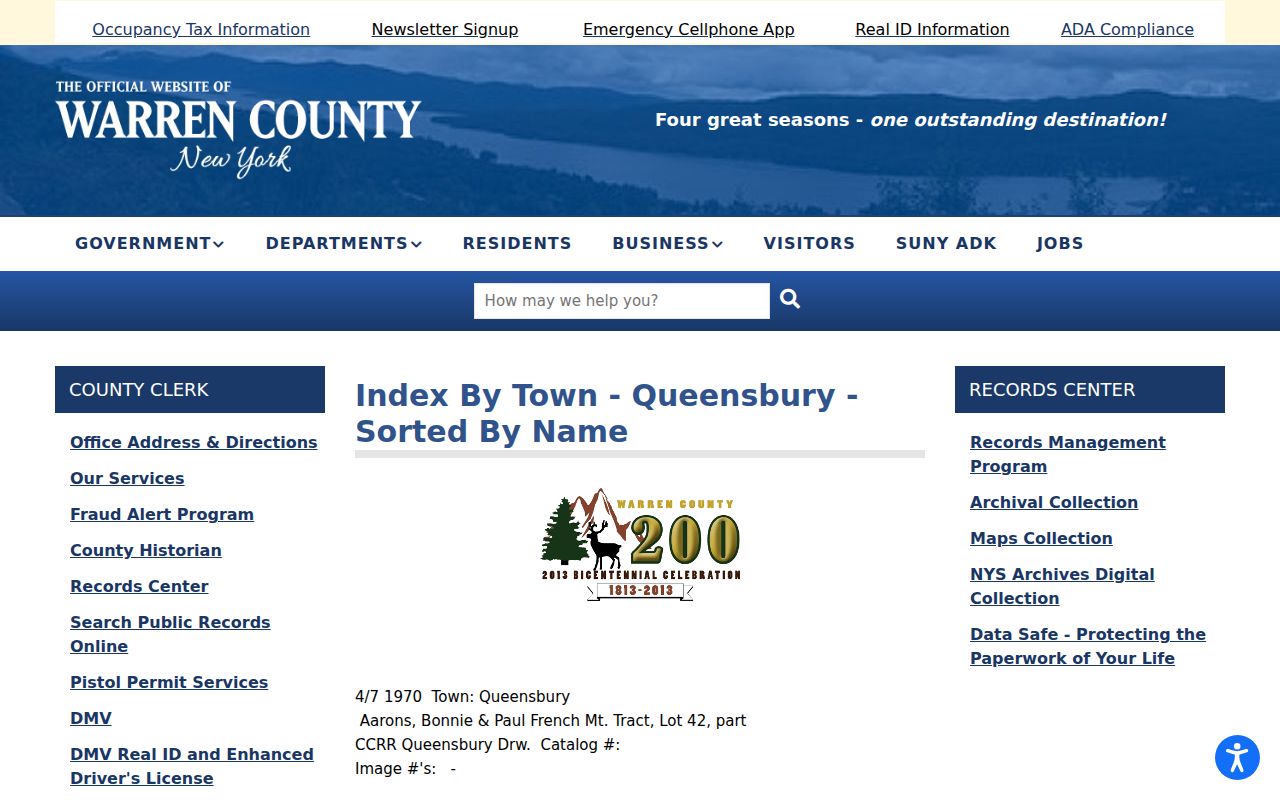
Save the catalog identifier, date, description, and image reference before contacting the Records Center. That preparation gives staff a defined series and date to check instead of a broad request for every item connected with a surname.
Queensbury Historian Record Requests
The Warren County Historian keeps surname files, town histories, family correspondence, settler and census indexes, wills and deed abstracts, military and church records, and cemetery transcripts. Its mail research service requires a written request, a stamped envelope, and a nonrefundable $15 payment to Warren County Treasurer. Give the researcher a narrow name, date range, place, and question. A general request for every record on a family is less likely to identify the useful series.
The Historian lists 1340 State Route 9, Room 7-122, Lake George, and 518-761-6544. Published hours conflict between a Monday/Wednesday schedule and a Monday-Friday schedule, so call before traveling. The John Austin collection, opened at the County Clerk's Record Room by appointment in 2026, is another hyperlocal family-history lead. Confirm the appointment, room, and copy rules with the Clerk before relying on access.
For a Town-held historical record that is not posted, Queensbury Code Chapter 130 supplies a written, mail, or in-person route under the New York Freedom of Information Law (FOIL), Public Officers Law Article 6 (§§84–90). Identify the record type, subject, and date range. The code permits privacy redactions, so a partial record may still be the lawful response.